
Time Management for Students: 12 Tips to Balance Classes, Study and Life
Between lectures, assignments, a part-time job, friends and sleep, there is never quite enough time as a student. The good news is that you don’t need more hours. You need a simple way to decide what matters, when it happens and what can wait.
This guide covers 12 practical time management tips for students, a simple weekly system and the tools that make it stick. For the planning side in detail, see our guide on how to create a study plan.
Quick answer: Good time management for students comes down to a few habits: keep every deadline in one planner, set a DO date to start each assignment early, pick three priorities a day, study in focused blocks with your phone away, plan your week every Sunday and protect sleep. Start with one or two habits and add more once they stick.
Why Time Management Is Hard for Students
- No fixed schedule. Free hours between classes are easy to lose.
- Far-away deadlines. An essay due in five weeks feels like a problem for later, until it isn’t.
- Many competing demands. Study, work, social life and family all want the same evenings.
- Constant distraction. Your phone is always one tap away.
All of these can be fixed with structure. Not rigid, every-minute structure, but a few simple rules you follow most of the time.
12 Time Management Tips for Students
1. Keep everything in one planner
Deadlines in your email, a calendar app, sticky notes and your head means something will slip. Put every class, deadline and exam in one place, paper or digital, and check it every day.
2. Set DO dates, not just due dates
A due date tells you when to hand something in. A DO date tells you when you will start. Set it one to two weeks before each deadline, and write it in your planner.
3. Pick a daily Top 3
Every morning, choose the three tasks that matter most today. Finish those and the day is a success, whatever else happens.
4. Sort by importance, not urgency
Urgent things shout loudest, but they aren’t always the most important. Ask: “What happens if this doesn’t get done this week?” Big assignments and revision usually win over replying to every message.
5. Break big assignments into small steps
“Write the dissertation” is impossible to start. “Find five sources for chapter 2” isn’t. Split every big project into steps you can finish in one session.
6. Use the gaps between classes
A free hour between lectures is perfect for one focused task, like reviewing notes or planning an essay. Over a week, those gaps add up to several hours.
7. Time block your week
Give each subject and task a block in your week, the same way your classes have one. Our time blocking for students guide shows how, with an example day.
8. Work in focused sessions
Study for 25 to 50 minutes with your phone in another room, then take a short break. The Pomodoro technique is a simple way to start.
9. Plan your week every Sunday
Spend 15 minutes looking at the week ahead: deadlines, exams, shifts and plans. Decide when each important task will happen before the week starts. Our weekly planner guide walks through a 15-minute routine.
10. Learn to say no, sometimes
Not every event, extra project or favour fits. If a yes means losing study time you need, a polite “not this week” is a time management skill.
11. Protect sleep
Late nights feel like extra time, but tired study is slow study. A regular bedtime makes every other hour more productive.
12. Build in rest and fun
A plan with no free time won’t last. Block time for friends, hobbies and doing nothing. It makes the study blocks easier to keep.
Common Student Time Wasters (and Fixes)
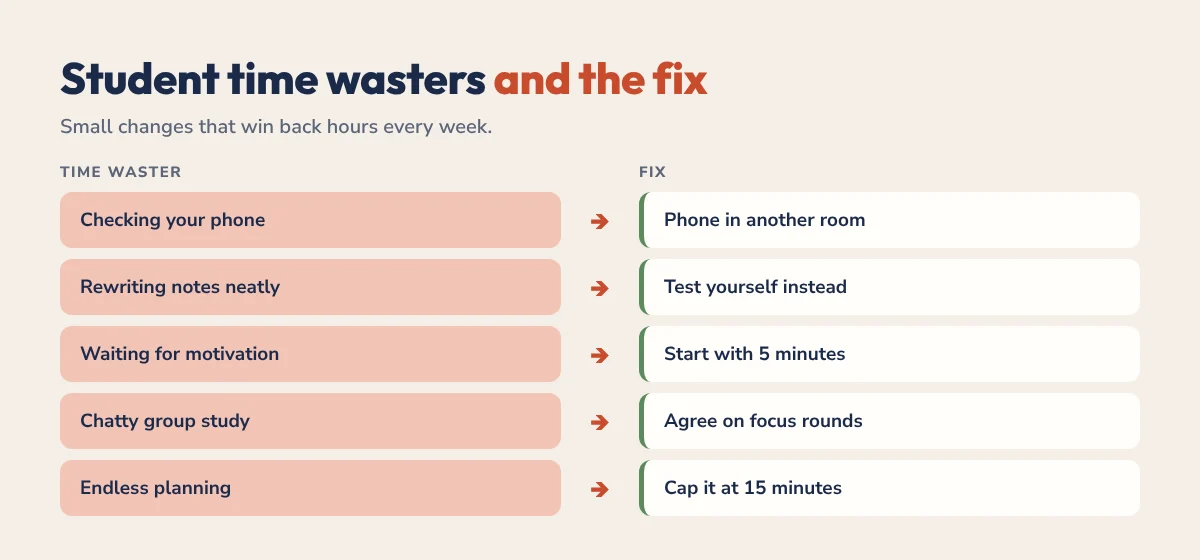
- Checking your phone “for a second”. Put it in another room or turn on a focus mode during study blocks.
- Rewriting notes neatly. It feels productive but rarely helps you remember. Test yourself instead.
- Waiting for motivation. Start with a five-minute task. Motivation usually shows up after you begin.
- Long “study sessions” with friends. Fun, but often more chat than study. Agree on focus rounds and breaks.
- Endless planning. Colour-coding a planner for an hour is not studying. Keep planning to 15 minutes.
A Simple Weekly Time Management System
| When | What to do | Time |
|---|---|---|
| Sunday | Plan the week: deadlines, DO dates, study blocks | 15 minutes |
| Every morning | Check the planner and pick a Top 3 | 5 minutes |
| During the day | Work in focused blocks, use gaps between classes | As planned |
| Every evening | Tick off tasks, move the rest to tomorrow | 5 minutes |
| Start of each month | Check upcoming exams and big deadlines | 10 minutes |
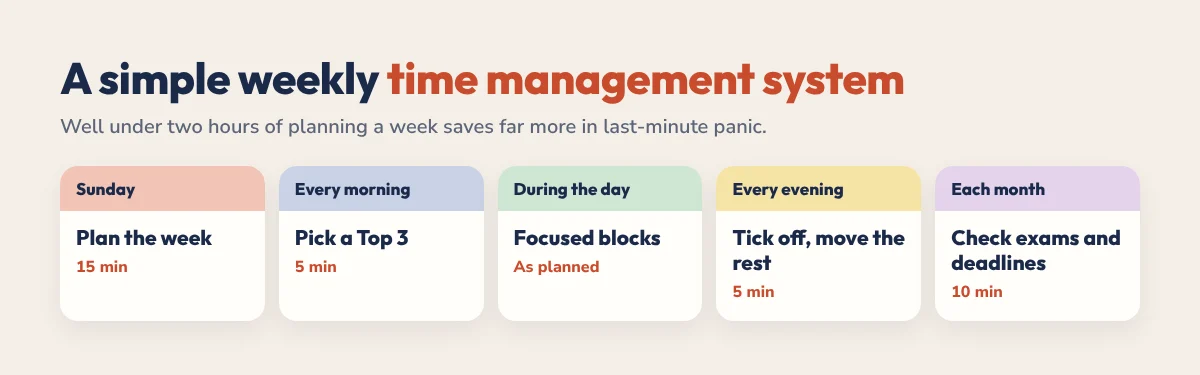
That’s well under two hours of planning a week, and it saves far more than that in last-minute panic.
Time Management for Students With a Job
- Add shifts first. Put work hours in your planner before you plan study.
- Study before shifts, not after. Energy is usually higher earlier in the day.
- Use short sessions. Two 45-minute blocks fit around most schedules.
- Tell your manager about exam weeks early. Ask for lighter shifts well in advance.
Time Management for Students With ADHD
If you have ADHD, strict schedules can be hard to keep. Loose time blocks, visual timers and a very short daily list often work better. Our ADHD time management guide and ADHD digital planner for college students guide go deeper.
Tools That Help
- A planner: paper or a digital planner on your tablet. See the best digital planner for university students.
- A calendar app: for classes and reminders.
- A timer: for focused study sessions.
- A website blocker: for study blocks when your phone or laptop keeps pulling you away.
Put this into practice with our free weekly study planner template, a one-page PDF you can print or use in GoodNotes.
Time Management for Students FAQ
What is the best time management technique for students?
There is no single best technique, but a weekly plan, DO dates for every deadline and a daily Top 3 work for most students. Add time blocking or Pomodoro sessions for focused study.
How can students manage time better?
Keep all deadlines in one planner, start assignments early with DO dates, study in focused blocks without your phone, plan every Sunday and protect your sleep.
How many hours should a student study per day?
It depends on your course. Many students aim for two to four focused hours outside class on most days, with more before exams. Focused time matters more than total hours.
How do I stop procrastinating as a student?
Make the first step tiny, set a short timer and remove distractions. Starting is the hardest part, and momentum usually carries you further once you begin.
How do I balance study, work and social life?
Put fixed commitments like classes and shifts in your planner first, block study time around them, then plan free time on purpose so it doesn’t eat into study blocks.
Start With Two Habits
Don’t try all 12 tips at once. This week, pick two: maybe DO dates and a Sunday plan. When they feel automatic, add the next.