
ADHD Time Management: 10 Strategies That Work With Your Brain
You sat down to answer one email. Now it is 3 pm, lunch never happened and the thing that was due at noon is still not done. If time seems to disappear on you, you’re not bad at time management. You’re using tools built for brains that feel time passing, and an ADHD brain often doesn’t.
This guide covers why time management is harder with ADHD and 10 practical strategies and tools that make time easier to see, plan and protect. It is part of our guide to executive dysfunction and ADHD.
Quick answer: ADHD time management works best when you make time visible instead of relying on feel. Use visual timers and analog clocks, plan your day in loose time blocks, add buffers between tasks, set alarms for transitions, and double your time estimates. Keep everything in one planner and review it daily, so time stops sneaking up on you.
Why Time Management Is Harder With ADHD
- Time blindness. Many people with ADHD struggle to sense time passing. Ten minutes and an hour can feel the same. Read more in our guide to ADHD time blindness.
- “Now” and “not now”. A deadline next week can feel unreal until it is suddenly tomorrow.
- Bad time estimates. Tasks are often planned as if they will take a fraction of the real time.
- Hyperfocus. Getting absorbed in something interesting can swallow whole afternoons.
- Hard transitions. Stopping one thing to start another takes extra effort, so you run late.
None of this is a character flaw. These are common executive function challenges, and they respond well to the right tools. See all 8 executive functioning skills for adults for the bigger picture.
10 ADHD Time Management Strategies
1. Make time visible
If you can’t feel time, you need to see it. A visual timer that shows time shrinking, an analog clock in every room or a countdown on your screen turns time from an idea into something you can watch.
2. Double your time estimates
Whatever you think a task will take, double it. If it finishes early, you get free time back. Over a few weeks, compare your guesses with reality and adjust.
3. Time block, but loosely
Give your tasks a place in the day instead of keeping them on an endless list. With ADHD, loose blocks such as morning, afternoon and evening often work better than strict hour-by-hour plans. Our time blocking for ADHD guide shows the full method.
4. Add buffers everywhere
Leave 10 to 15 minutes between tasks and arrive at things early on purpose. Buffers absorb the delays that would otherwise wreck the rest of your day.
5. Set alarms for transitions, not just events
An alarm at 2 pm for a 2 pm meeting is too late. Set one for when you need to stop what you are doing and get ready, like 1:45. Our ADHD calendar guide shows how to set this up.
6. Work in short rounds
Short, timed rounds make starting easier and stop one task from eating your day. The Pomodoro technique uses 25 minutes of focus and a 5-minute break, but 15 minutes is fine on hard days.
7. Use DO dates, not just due dates
A due date tells you when something must be finished. A DO date tells you when you will start. Put DO dates in your planner a few days or weeks before each deadline.
8. Plan tomorrow tonight
Spend five minutes in the evening choosing tomorrow’s Top 3 and giving each a block. You will wake up already knowing where to start, which saves your best energy for doing.
9. Guard against hyperfocus
Before starting something absorbing, set a hard stop alarm and decide what you will do next. Writing the next task down makes it easier to switch when the alarm rings.
10. Keep one planner and review it daily
Time management falls apart when tasks live in five places. Use one planner for everything and look at it every morning. A hyperlinked digital planner makes this faster, because every page is one tap away.
Losing your best hours to meetings? See how to protect focus time with ADHD.
The Best ADHD Time Management Tools
| Tool | What it helps with | Example |
|---|---|---|
| Visual timer | Seeing time pass | A timer app or a physical countdown timer |
| Analog clock | Feeling how much time is left | A wall clock in your workspace |
| Calendar with alerts | Remembering fixed events | Google Calendar or Apple Calendar |
| Digital planner | Planning the day and week | A hyperlinked PDF in GoodNotes |
| Time blocking app | Scheduling tasks automatically | See our app roundup below |
| Focus timer | Working in short rounds | Any Pomodoro-style timer |
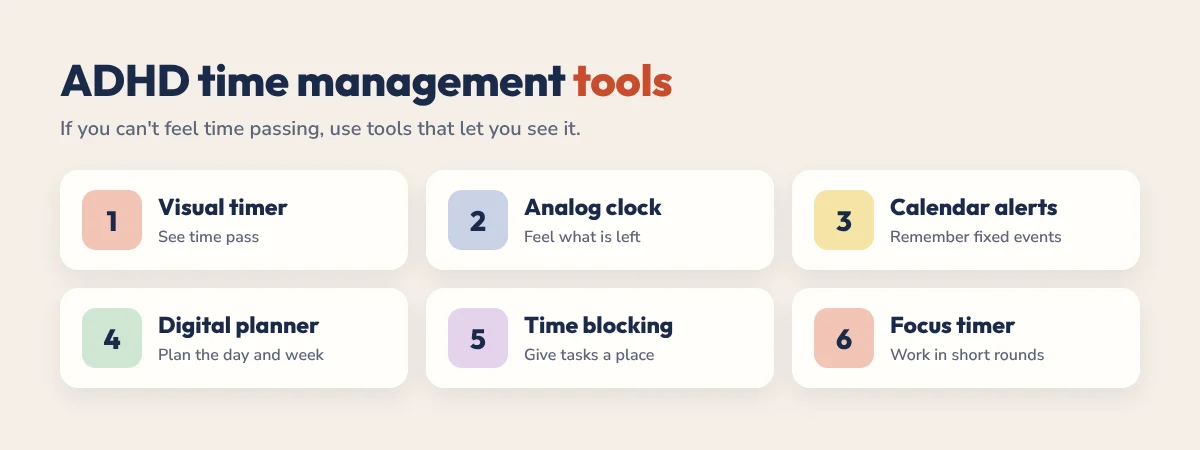
If you prefer apps, our roundup of the best time blocking apps for ADHD compares the main options. Many people get the best results by combining a calendar for fixed events with a planner for daily focus.
A Simple Daily Time Management Routine
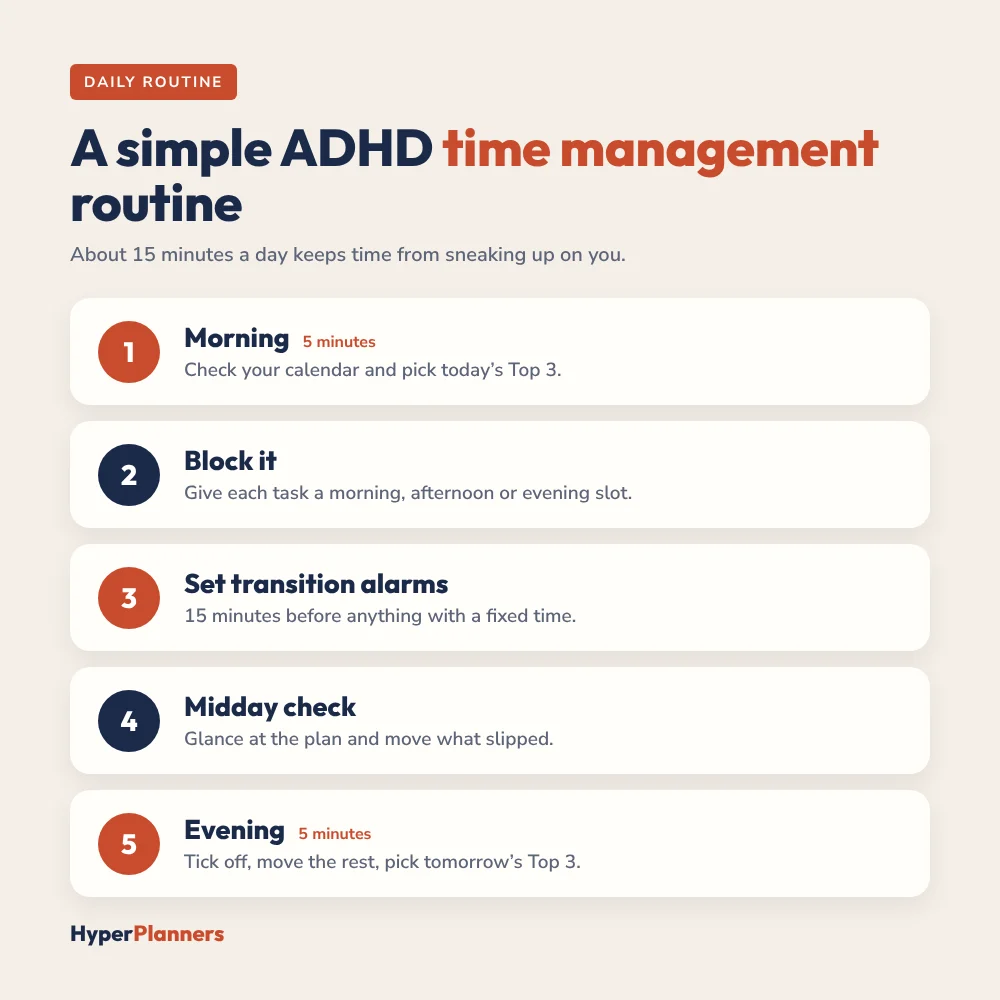
- Morning (5 minutes): Look at your calendar and pick today’s Top 3.
- Block it: Give each Top 3 task a morning, afternoon or evening slot, with buffers in between.
- Set transition alarms: Add alarms 15 minutes before anything with a fixed time.
- Midday check: Glance at the plan and move anything that slipped.
- Evening (5 minutes): Tick off what got done, move the rest and pick tomorrow’s Top 3.
When you get stuck between tasks, a dopamine menu gives you a quick, healthy reset instead of a long scroll.
When Time Management Feels Impossible
Some days the strategies won’t work, and that’s normal. If you’re stuck and can’t start anything, our ADHD task paralysis guide can help. If time management problems are affecting your work, studies or wellbeing over a long period, talk to a doctor or ADHD specialist about support.
A Planner That Makes Time Visible
Our free ADHD planner was built for this. Each day has a Top 3, loose time blocks, a brain dump and a dopamine menu, and it works in GoodNotes, Notability or any PDF app.
Try it now: build your own routine in 2 minutes with our free ADHD daily schedule builder. It plans your day around your energy peak.
ADHD Time Management FAQ
Why is time management so hard with ADHD?
Many people with ADHD experience time blindness, find it hard to estimate how long tasks take and struggle with transitions. These are executive function challenges, not a lack of effort.
What is the best time management technique for ADHD?
There is no single best technique, but making time visible works for most people. Visual timers, loose time blocking and transition alarms are a strong place to start.
What is time blindness?
Time blindness is difficulty sensing how much time has passed or how long something will take. It is common with ADHD and is a big reason people run late or miss deadlines.
Do time management apps help with ADHD?
They can, especially for reminders and fixed events. Many people pair an app or calendar with a simple planner, so they have alerts and a clear daily plan in one place.
How can I stop losing track of time with ADHD?
Use a visible timer for every task, set alarms for when to stop, and keep a clock in sight. Before starting something absorbing, decide on a hard stop time.
Start Small
Pick one strategy from this list, like a visible timer or a Top 3, and use it every day this week. When it becomes automatic, add the next one.