
Executive Functioning Skills for Adults: 8 Skills and Everyday Ways to Build Them
Executive functioning skills are what turn intentions into action. They help you plan a week, remember the second step, start the boring task and stay calm when the plan falls apart. Some adults have them in good supply. Many, especially people with ADHD, have to work around gaps every day.
This guide covers the 8 main executive functioning skills for adults, what each looks like in real life, and simple everyday activities and tools that support them. For the bigger picture, see our guide to executive dysfunction and ADHD.
Quick answer: The main executive functioning skills for adults are working memory, self-control, flexible thinking, planning and prioritising, organisation, task initiation, time management and emotional regulation. You build them less by “training your brain” and more by practising small daily habits with outside support: written lists, timers, routines, checklists and a planner you review every day.
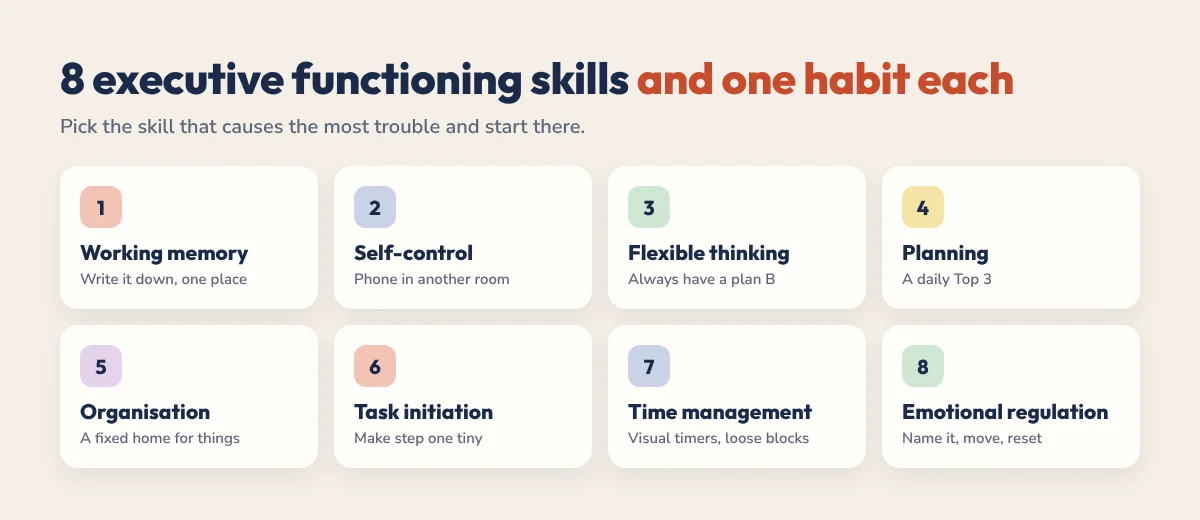
The 8 Executive Functioning Skills at a Glance
| Skill | What it does | Everyday example |
|---|---|---|
| Working memory | Holds information while you use it | Remembering a phone number while you dial |
| Self-control | Stops you acting on every impulse | Not opening social media mid-task |
| Flexible thinking | Adapts when things change | Finding a new route when the road is closed |
| Planning and prioritising | Decides what matters and in what order | Choosing three tasks for today |
| Organisation | Keeps things and information in order | Knowing where your passport is |
| Task initiation | Gets you started | Opening the report instead of avoiding it |
| Time management | Estimates and tracks time | Leaving on time for an appointment |
| Emotional regulation | Manages frustration and stress | Staying calm when a plan falls apart |
How to Build Each Skill in Daily Life
Research suggests that brain-training games mostly make you better at the games themselves. What helps more in daily life is building habits and using tools that support each skill. Pick one or two skills to start with, not all eight.
1. Working memory
- Write things down the moment you think of them, in one place.
- Repeat instructions back out loud before you start.
- Use checklists for routines you do often, like leaving the house.
- Do a daily brain dump to clear your head. See our brain dump method.
2. Self-control
- Put your phone in another room during focus time.
- Use a “wait 10 minutes” rule before buying or replying to something.
- Block distracting websites during work hours.
- Decide your limits in advance, like one episode, not “a bit of TV”.
3. Flexible thinking
- When a plan breaks, ask “What is plan B?” instead of starting over.
- Build buffer time into your day so changes don’t wreck everything.
- Practise small changes on purpose, like a new route to work.
- Use loose plans, such as morning and afternoon, instead of exact times.
4. Planning and prioritising
- Choose a daily Top 3 instead of working from a long list.
- Break big tasks into steps small enough to start in five minutes.
- Do a 15-minute weekly plan every Sunday.
- Ask “What happens if this doesn’t get done?” to sort important from urgent.
5. Organisation
- Give every important item a fixed home, like a hook for keys.
- Use one planner and one to-do list, not five.
- Do a 10-minute tidy at the end of each day.
- Keep digital files in a few simple folders.
6. Task initiation
- Make the first step tiny: “open the document”, not “write the report”.
- Set a timer for 10 minutes and agree to stop after that if you want.
- Use body doubling: work alongside someone in person or online.
- Our task paralysis guide has more ideas for getting started.
7. Time management
- Use a visual timer so you can see time passing.
- Double your time estimates.
- Set alarms for when to stop, not just when to start.
- Plan your day in loose time blocks. Our ADHD time management guide covers this in depth.
8. Emotional regulation
- Name the feeling: “I’m frustrated”, not “this is impossible”.
- Take a short movement break before reacting.
- Keep a dopamine menu of quick, healthy resets.
- Get enough sleep. Tired brains find every skill harder.
A Simple Weekly Routine That Trains Several Skills at Once
You don’t need separate exercises for each skill. One weekly planning session works on most of them together:
- Brain dump everything on your mind (working memory).
- Pick the week’s priorities and break big tasks into steps (planning).
- Put tasks into days and loose time blocks, with buffers (time management and flexibility).
- Choose a tiny first step for your hardest task (task initiation).
- Tidy your planner and workspace for 10 minutes (organisation).
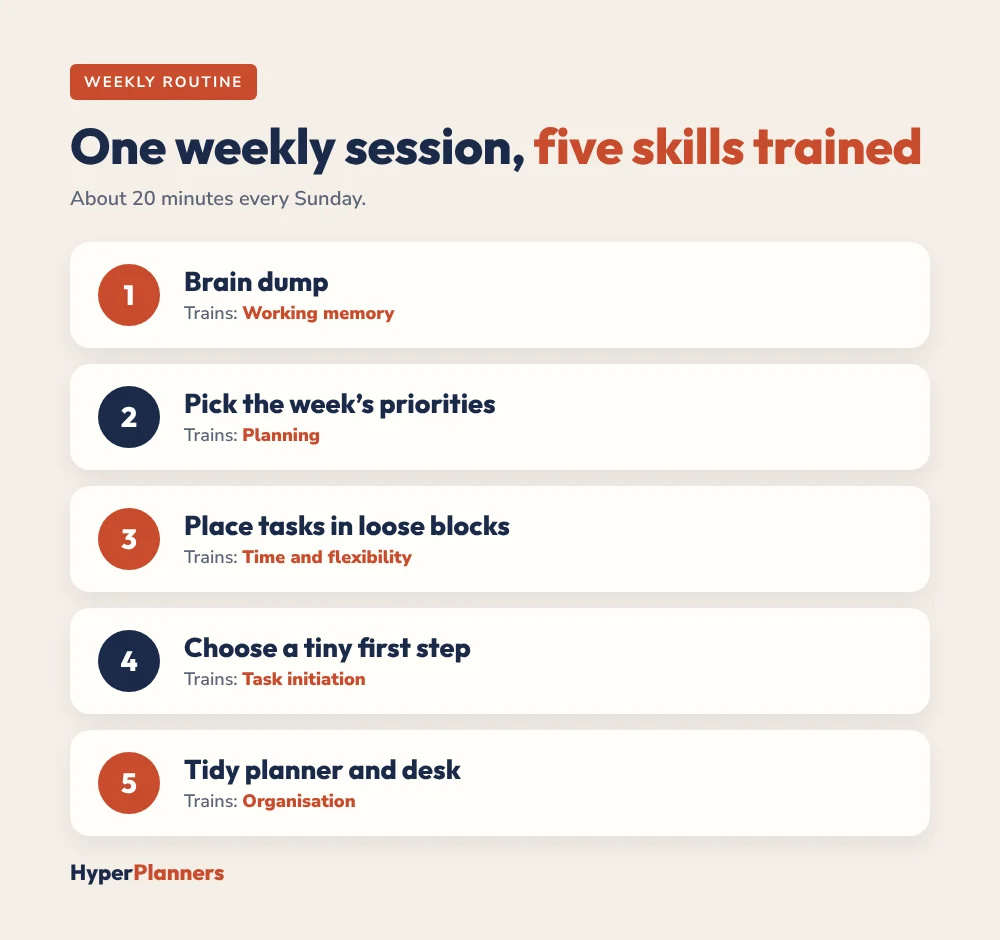
Repeat it every week. The routine becomes easier, and so do the skills behind it.
Executive Functioning Skills at Work
- Meetings: write down actions before you leave the room.
- Email: check it in two or three set blocks, not all day.
- Projects: break them into weekly milestones with DO dates.
- Deep work: block your hardest task in your best-energy hours. Our time blocking guide shows how.
When to Get Support
Everyone struggles with these skills sometimes, especially when stressed or tired. If difficulties are ongoing and affecting your work, relationships or wellbeing, talk to a doctor or psychologist. They can check whether ADHD or another condition is involved and point you to support such as therapy, coaching or treatment.
A Planner That Supports Executive Function
A good planner is an external brain for most of these skills. Our free ADHD planner has a daily Top 3, a brain dump, loose time blocks and a dopamine menu, all hyperlinked so you can move around in one tap.
Executive Functioning Skills FAQ
What are executive functioning skills in adults?
They are the mental self-management skills adults use every day: working memory, self-control, flexible thinking, planning and prioritising, organisation, task initiation, time management and emotional regulation.
Can adults improve executive functioning skills?
Yes, many adults get better at managing them with practice, routines and outside tools like planners, timers and checklists. Support for any underlying condition, such as ADHD, can also help.
Do brain-training games improve executive function?
The evidence suggests they mostly improve performance on the games themselves, with limited effect on daily life. Practising real-life habits and using supportive tools tends to be more useful.
What are examples of executive function tasks?
Planning a week, following a recipe, remembering an appointment, starting a work project, keeping track of bills and staying calm when plans change are all everyday executive function tasks.
Which executive functioning skill should I work on first?
Start with the one causing the most trouble. For many people that is task initiation or time management, because improving them makes the other skills easier to practise.
Start With One Skill
Pick the skill on this list that causes you the most trouble and try two of its ideas this week. Small, repeated habits do more than any big overhaul.