
Executive Dysfunction and ADHD: What It Looks Like and What Helps
You know exactly what you need to do. You might even want to do it. And yet you sit there, unable to start, while the task gets bigger in your head. If that sounds familiar, you have met executive dysfunction. It is one of the most common and most frustrating parts of living with ADHD, and it has nothing to do with being lazy.
This guide explains what executive function is, how executive dysfunction shows up with ADHD, and practical tools that make daily life easier. It is the starting point for our ADHD planning guides, so you will find links to deeper help on each topic along the way.
Quick answer: Executive dysfunction means difficulty with the brain’s self-management skills: starting tasks, planning, remembering, managing time, switching focus and handling emotions. It is very common in ADHD. It can’t be fixed with willpower, but it can be worked around by moving things out of your head and into your environment: write tasks down, break them into small steps, make time visible with timers and time blocks, and cut down the number of decisions you make each day.
What Is Executive Function?
Executive function is the set of mental skills you use to manage yourself: to plan, stay on track and get things done. A common way to describe it is as the brain’s air traffic control. It decides what needs attention, in what order, and when to switch.
Researchers usually describe three core skills, with others built on top of them:
- Working memory: holding information in mind while you use it, like remembering the second step while doing the first.
- Inhibition (self-control): stopping yourself from acting on every impulse or distraction.
- Cognitive flexibility: switching between tasks or changing your plan when something changes.
From these come everyday skills like planning, organising, managing time, starting tasks and regulating emotions. Our guide to executive functioning skills for adults covers all eight, with everyday ways to build each one.
What Is Executive Dysfunction?
Executive dysfunction is the term for having real, ongoing difficulty with those skills. It isn’t a diagnosis on its own. It shows up in ADHD, and it can also appear with autism, depression, anxiety, chronic stress, poor sleep and brain injuries.
With ADHD, executive function difficulties are so central that many experts, including psychologist Russell Barkley, describe ADHD itself as a problem of self-regulation rather than just attention. That said, not everyone with ADHD struggles with the same skills, or to the same degree.
Signs of Executive Dysfunction in Adults
- Trouble starting tasks, even ones you care about. Our ADHD task paralysis guide covers this in depth.
- Time blindness: losing track of time, running late or underestimating how long things take.
- Forgetting appointments, tasks and what you walked into a room for.
- Overwhelm with multi-step tasks, like taxes, moving house or a big work project.
- Losing things, such as keys, phones and important papers.
- Hard switches: struggling to stop one activity and start another.
- Big emotions that feel hard to manage, especially frustration.
- Unfinished projects, started with energy and left halfway.
Everyone does these things sometimes. Executive dysfunction is when they happen often enough to get in the way of work, study, relationships or daily life.
Executive Function Skills and the Tools That Help
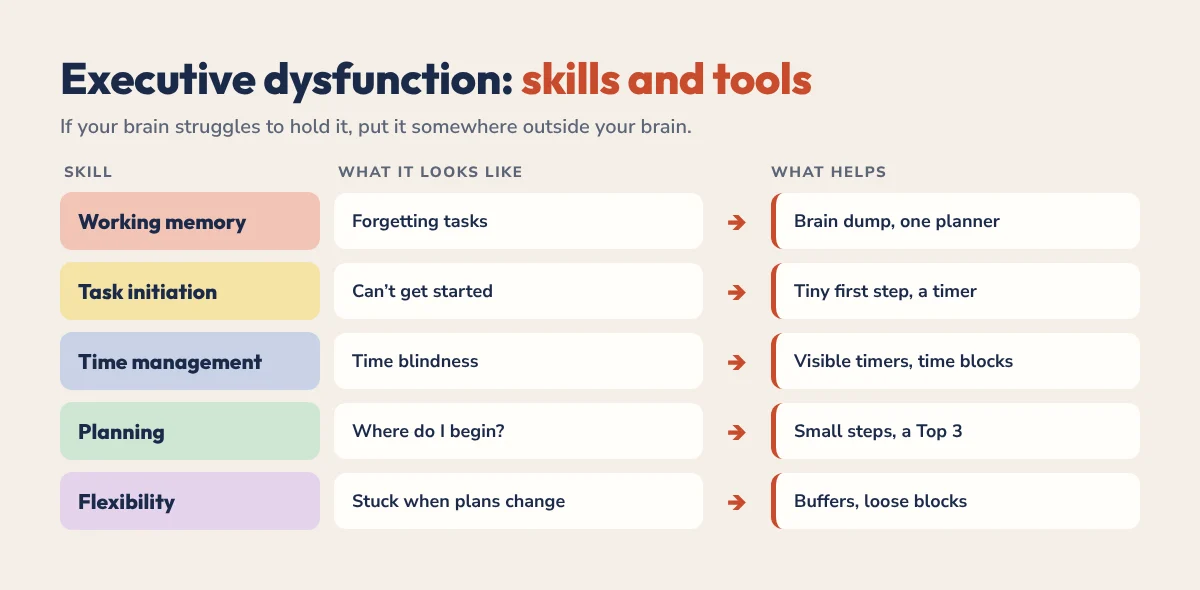
The most useful idea for managing executive dysfunction is this: if your brain struggles to hold it, put it somewhere outside your brain. Each skill has a matching tool:
| Skill | What the difficulty looks like | What helps |
|---|---|---|
| Working memory | Forgetting tasks and steps | Brain dump, written lists, one planner |
| Task initiation | Can’t get started | Tiny first steps, a timer, a dopamine boost |
| Time management | Running late, time blindness | Visible timers, time blocking |
| Planning | Not knowing where to begin | Breaking tasks into steps, a Top 3 |
| Organisation | Lost items, messy systems | Fixed homes for things, fewer systems |
| Flexibility | Stuck when plans change | Buffer time, loose time blocks |
| Emotional regulation | Frustration, shutdown | Breaks, movement, self-compassion |
7 Practical Strategies for Executive Dysfunction
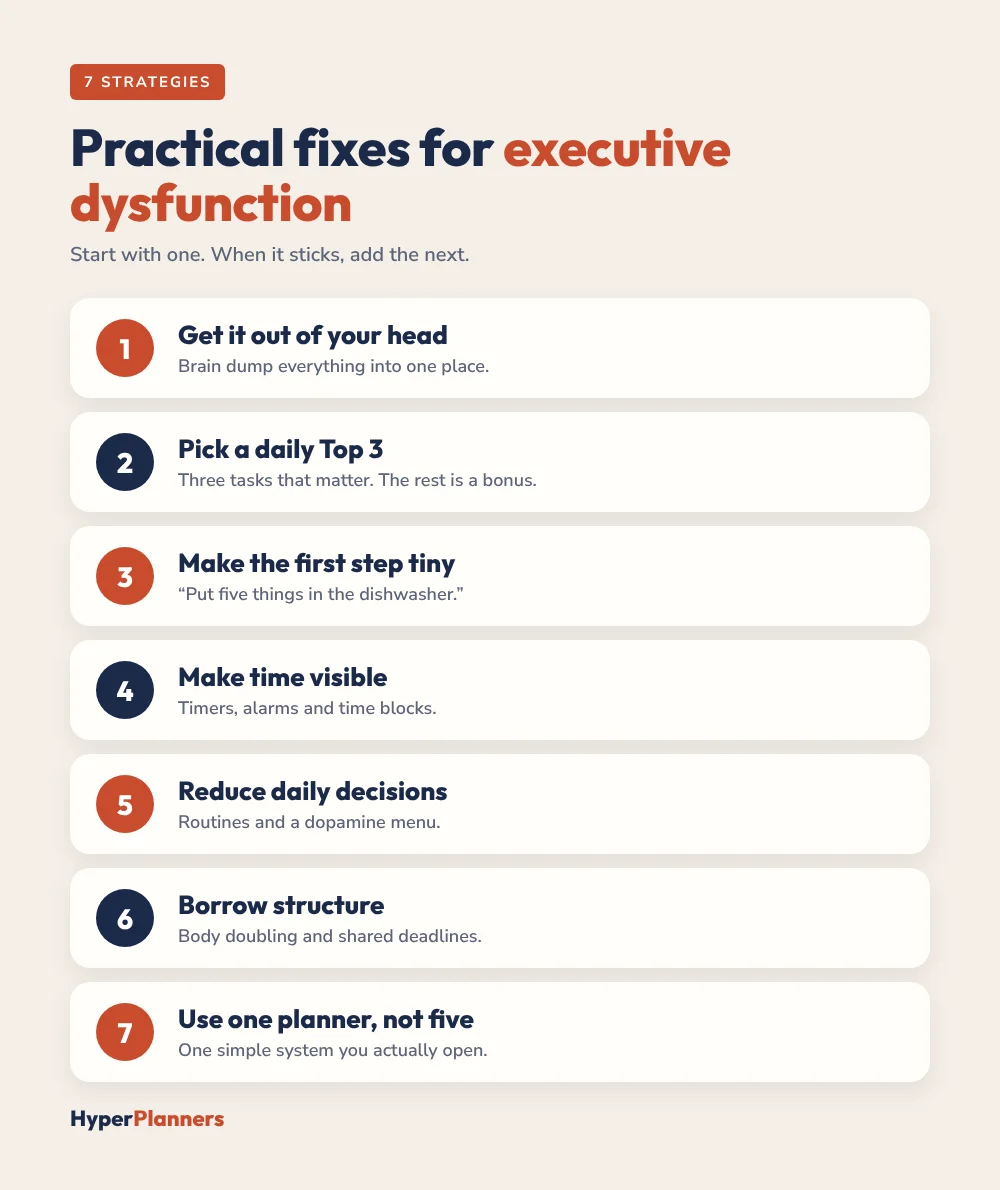
1. Get it out of your head
Working memory is limited, so stop asking it to store your to-do list. Write everything down in one place. A daily brain dump clears the mental noise. See our ADHD brain dump method.
2. Pick a daily Top 3
A list of twenty tasks is a recipe for freezing. Choose three that matter most today. Anything else is a bonus.
3. Make the first step tiny
“Clean the kitchen” is vague and heavy. “Put five things in the dishwasher” is easy to start. Once you start, momentum often carries you further.
4. Make time visible
If you can’t feel time passing, you need to see it. Use a visual timer, set alarms for transitions, and plan your day in blocks. Our time blocking for ADHD guide shows a loose method that survives a messy day, and the Pomodoro technique helps you work inside each block. For 10 more ideas, see our ADHD time management guide.
5. Reduce daily decisions
Every decision uses energy. Routines, a fixed weekly reset and ready-made choices save it for what matters. A dopamine menu does this for breaks and motivation.
6. Borrow structure from other people
Body doubling, working alongside someone in person or on a video call, makes it easier to start and keep going. Deadlines shared with a friend work the same way.
7. Use one planner, not five
Multiple apps, notebooks and sticky notes mean nothing is ever in one place. Pick one system and keep it simple. A hyperlinked digital planner keeps every page one tap away, which helps when your attention is short.
Executive Dysfunction at Work and School
The same tools apply, with a few extras. At work, block your hardest task in the morning, batch email into one or two slots and write meeting actions down before you leave the room. At school or university, track DO dates instead of only due dates and spread study across the week. Our time blocking for students guide walks through it.
When to Get Professional Support
Tools and planners help, but they aren’t a replacement for proper support. If executive dysfunction is affecting your job, studies, relationships or wellbeing, talk to your doctor or a mental health professional. An assessment can confirm whether ADHD or something else is behind it, and support can include medication, therapy, ADHD coaching and workplace or school adjustments.
A Planner Built for Executive Dysfunction
Our free ADHD planner was designed around the strategies above. Each day has a Top 3, a brain dump, loose time blocks and a dopamine menu, plus a no-guilt restart button for days that go sideways. Comparing options? See how to choose an ADHD planner for adults. It is a hyperlinked PDF that works in GoodNotes, Notability and any PDF app.
Read more about what is inside in our free ADHD planner guide.
Try it now: our free ADHD focus tool has a 15, 25 or 50-minute timer, a task breaker and a dopamine boost button for when you feel stuck.
Executive Dysfunction FAQ
What is executive dysfunction in ADHD?
It is difficulty with the brain’s self-management skills, such as starting tasks, planning, remembering, managing time and handling emotions. It is very common in ADHD and is one of the main reasons daily tasks can feel so hard.
Is executive dysfunction the same as laziness?
No. Laziness is not wanting to do something. Executive dysfunction is wanting to do something and struggling to make your brain start, organise or finish it.
Can executive dysfunction be improved?
Many people manage it well with the right strategies and support. External tools like planners, timers and routines help day to day, and professional treatment for ADHD can make a big difference.
What are examples of executive dysfunction?
Not being able to start a task, losing track of time, forgetting appointments, feeling overwhelmed by multi-step jobs, losing things and finding it hard to switch between activities.
Does only ADHD cause executive dysfunction?
No. It can also appear with autism, depression, anxiety, chronic stress, lack of sleep and brain injuries. A doctor can help work out the cause.
Start With One Small Change
You don’t need to fix everything at once. This week, try one thing: a daily brain dump, a Top 3 or a visible timer. When it sticks, add the next. Small systems that you actually use beat a perfect system you abandon.