
Weekly Reset Routine: A Sunday Checklist to Start Monday Calm
Sunday evening can go two ways. Either a vague dread about everything waiting on Monday, or a quiet sense that you know what’s coming and you’re ready for it. The difference is usually a simple weekly reset: an hour or less to tidy your space, clear your head and plan the week ahead.
This guide gives you a complete weekly reset routine in four parts, a printable-style checklist, a 20-minute version for busy weeks and tips to make the habit stick. It works hand in hand with our weekly planner guide.
Quick answer: A weekly reset is a short routine, usually on Sunday, that gets your space, mind and plan ready for the week. It has four parts: reset your space (a quick tidy and laundry), reset your mind (brain dump and reflect on last week), reset your plan (calendar, three weekly goals, meal plan) and reset yourself (rest and something you enjoy). The full version takes about an hour, and a 20-minute version works on busy weeks.
What Is a Weekly Reset?
A weekly reset is a set routine you do once a week to close out the old week and prepare for the new one. Instead of starting Monday reacting to emails and a messy kitchen, you start with a clear plan, a clean space and a calmer head.
It isn’t a deep clean or a full day of productivity. The point is to do a few high-value things that make the next seven days easier.
Why a Weekly Reset Works
- It closes open loops. Writing everything down stops your brain from replaying the to-do list all weekend.
- It cuts Monday decisions. You already know your first three tasks, so the week starts with action, not planning.
- It catches problems early. A clash on Thursday or a missing ingredient is easy to fix on Sunday, not at 6 pm on the day.
- It builds a rhythm. One fixed point each week makes it easier to restart, even after a chaotic week.
Think of it as maintenance. Ten minutes of tidying and planning now saves hours of scrambling later in the week.
The 4 Parts of a Weekly Reset
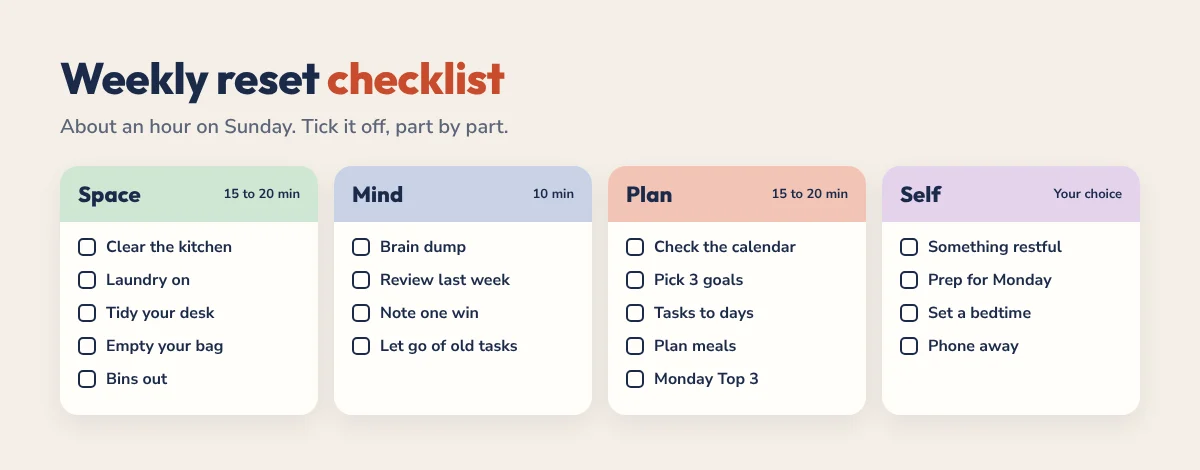
1. Reset your space (15 to 20 minutes)
- Clear the kitchen and run the dishwasher
- Put a load of laundry on
- Tidy your desk or workspace
- Empty your bag and put things back where they live
- Take out the bins and recycling
2. Reset your mind (10 minutes)
- Brain dump everything on your mind onto one page
- Look back at last week: what went well, what didn’t
- Note one win, however small
- Decide what to let go of from last week’s list
The brain dump is the most important step. Our brain dump method shows how to sort it afterwards.
3. Reset your plan (15 to 20 minutes)
- Check your calendar for the week and add anything missing
- Pick three goals for the week
- Give each important task a day
- Plan meals for at least three dinners and write a shopping list
- Set Monday’s Top 3
For the planning step in detail, see how to make a weekly schedule.
4. Reset yourself (as long as you like)
- Do something restful: a walk, a bath, a book
- Prepare tomorrow’s clothes and bag
- Set a reasonable bedtime
- Put your phone away for the last hour
Weekly Reset Checklist
| Part | Checklist | Time |
|---|---|---|
| Space | Kitchen, laundry, desk, bag, bins | 15 to 20 min |
| Mind | Brain dump, review last week, note one win | 10 min |
| Plan | Calendar, three goals, tasks to days, meals, Monday Top 3 | 15 to 20 min |
| Self | Rest, prep for Monday, early night | Your choice |
The 20-Minute Reset for Busy Weeks
Some weeks an hour isn’t realistic. On those weeks, do just this:
- 5 minutes: clear the kitchen and your desk.
- 5 minutes: brain dump everything on your mind.
- 5 minutes: check the calendar and pick three goals.
- 5 minutes: set Monday’s Top 3 and lay out what you need for the morning.
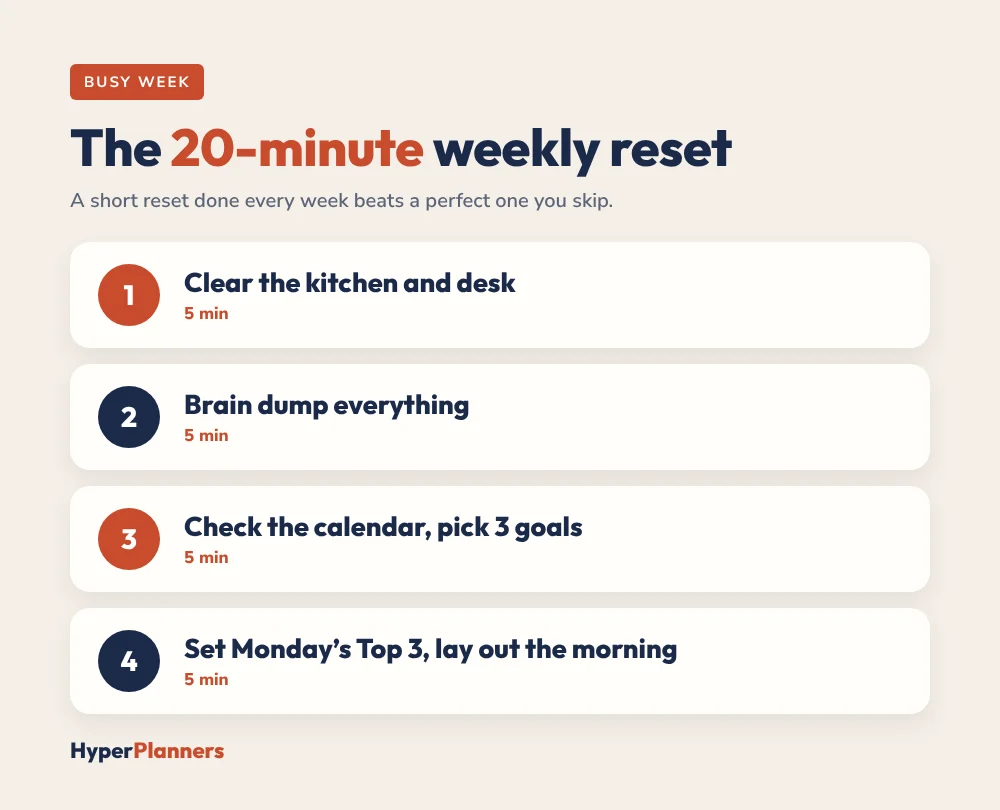
A short reset done every week beats a perfect one you skip.
Tips to Make the Weekly Reset Stick
- Same time every week. Sunday afternoon or evening works for most people. Put it in your calendar.
- Make it pleasant. Music, a favourite drink, a candle. It should feel like a ritual, not a chore.
- Use a checklist. Don’t rely on memory. Tick things off.
- Keep it short. If it takes more than an hour, cut steps rather than skipping it entirely.
- Pair it with a reward. A film, a call with a friend or a nice dinner afterwards.
Weekly Reset With ADHD
If you have ADHD, a reset can easily turn into a three-hour deep clean or never start at all. Set a timer for each part, use a body double if it helps, and focus on the plan more than the tidy. A short, imperfect reset is still a win. Our ADHD planner guide and ADHD time management guide have more ideas.
Do Your Reset in a Planner
A planner keeps your reset in one place: the brain dump, last week’s wins, this week’s goals and Monday’s Top 3. Our free time blocking template has a weekly page and daily pages you can print or use in GoodNotes and Notability, and our free 2027 digital planners include weekly pages too.
Try it now: track your habits with our free, printable ADHD habit tracker. No streaks to break, just tap the days you show up.
Weekly Reset FAQ
What is a weekly reset?
A weekly reset is a short routine, usually on Sunday, where you tidy your space, clear your head with a brain dump, plan the week ahead and take time to rest.
How long should a weekly reset take?
About 45 minutes to an hour for the full version. On busy weeks, a 20-minute version covering a quick tidy, a brain dump, three goals and Monday’s Top 3 works well.
What day is best for a weekly reset?
Sunday is the most popular because it prepares you for Monday. Any day works if you can repeat it every week.
What should be on a weekly reset checklist?
Tidy the kitchen and desk, do laundry, brain dump, review last week, check your calendar, pick three goals, plan meals, set Monday’s Top 3 and plan some rest.
Is a weekly reset good for ADHD?
Many people with ADHD find it helpful because it creates a regular point to catch up and replan. Keep it short, use a timer and focus on planning more than cleaning.
Try It This Sunday
Pick a time, grab a planner and work through the four parts. Even the 20-minute version will make Monday feel lighter.