
ADHD Planner for Women: How to Plan Around Energy, Mental Load and Real Life
Many women with ADHD are diagnosed later in life, often after years of holding everything together with lists, late nights and sheer effort. By the time you look for an ADHD planner, you’re usually juggling work, home, family and your own needs, and most planners only cover one of those.
This guide covers what women with ADHD often need from a planner, the pages that help most, and a simple way to plan around changing energy instead of fighting it. For the full checklist, see our guide to choosing an ADHD planner for adults.
Quick answer: A good ADHD planner for women keeps work, home and personal life in one place, makes the invisible mental load visible with a brain dump, plans each day around energy with a short Top 3, and includes simple trackers for mood, energy and, if you want, your cycle. Look for hyperlinked pages, easy restarts and room for self-care, not just tasks.
Why Planning Can Feel Different for Women With ADHD
- The mental load. Remembering birthdays, school forms, meals and appointments often lands on the same person. With ADHD, holding it all in your head is exhausting.
- Years of masking. Many women build hidden coping systems that work until life gets busier, then suddenly don’t.
- Changing energy. Many women notice their focus and energy shift across the month, and some report that ADHD symptoms feel stronger at certain times.
- Guilt. A missed task can feel like a personal failure, which makes it harder to open the planner the next day.
None of this means you need a more complicated planner. It means you need one that is flexible, forgiving and covers your whole life.
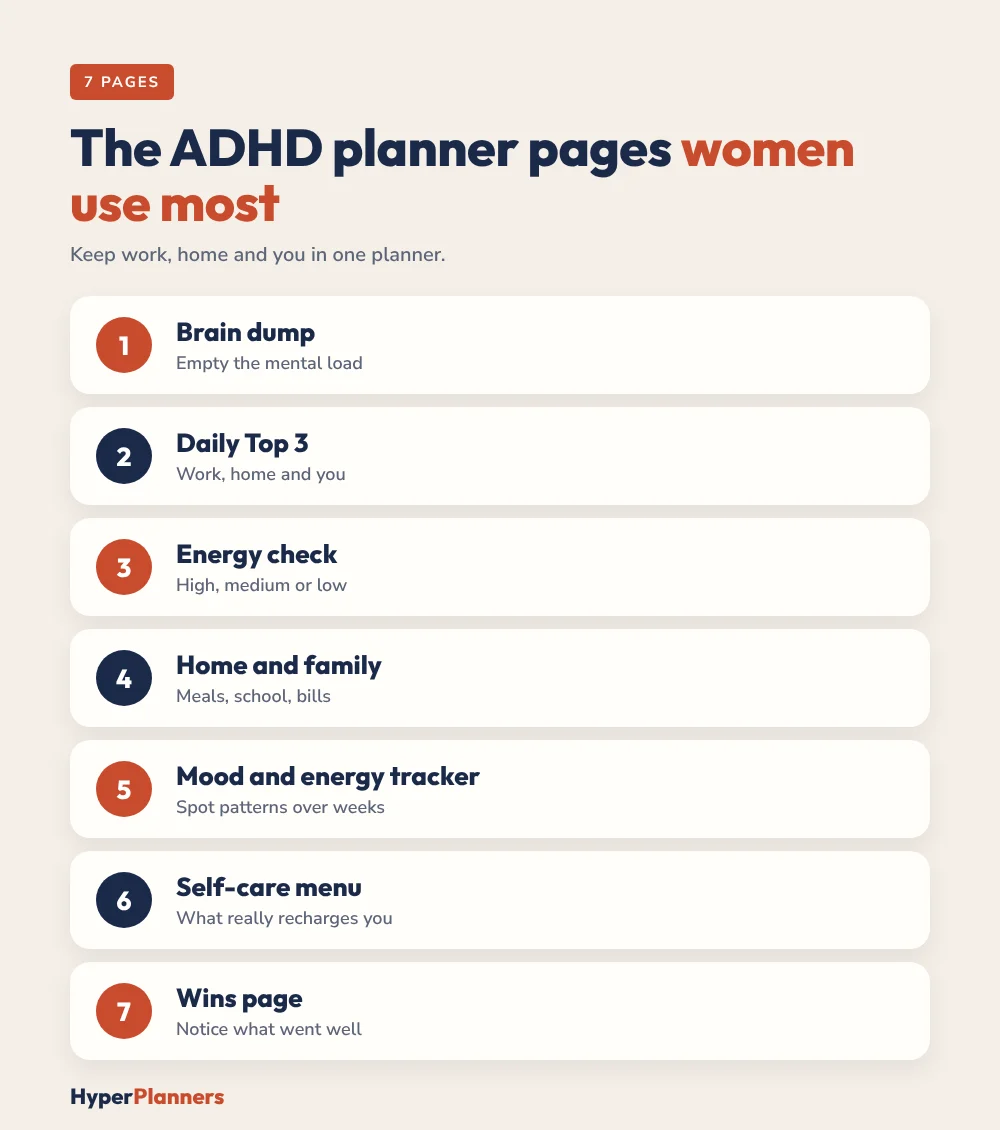
7 Pages That Help Most
- Brain dump. Empty the mental load onto one page so you can stop carrying it in your head.
- Daily Top 3. Three priorities across work, home and you. Not twenty.
- Energy check. A quick high, medium or low note each morning, so you can plan the day to match.
- Home and family page. Meals, school dates, bills and household jobs in one place.
- Mood and energy tracker. Spot patterns over weeks, not just days.
- Self-care menu. A short list of things that genuinely help you recharge. See our dopamine menu guide.
- Wins page. A place to notice what went well, because ADHD brains often remember only what didn’t.
Plan Around Your Energy, Not Against It
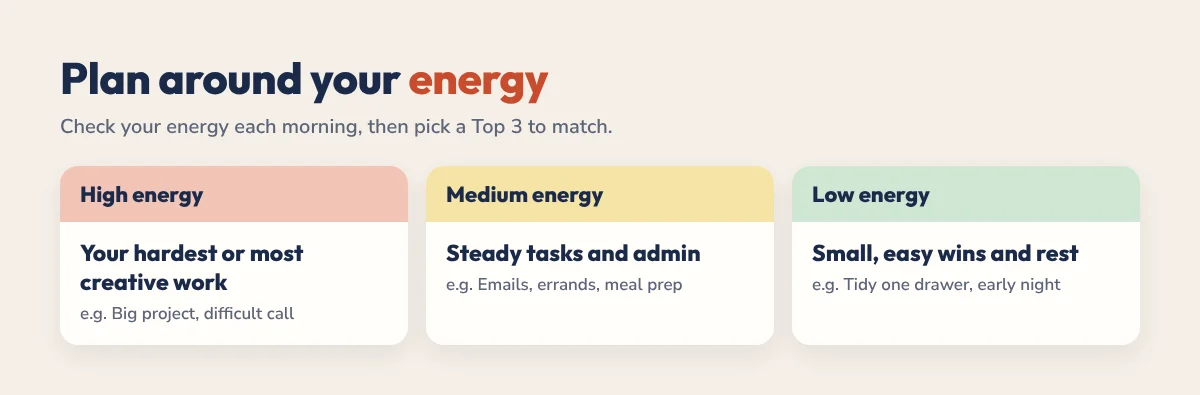
Instead of planning every day the same way, match your plan to how you feel:
| Energy | What to plan | Example |
|---|---|---|
| High | Your hardest or most creative work | Big project, difficult call, deep cleaning |
| Medium | Steady tasks and admin | Emails, errands, meal prep |
| Low | Small, easy wins and rest | Tidy one drawer, order groceries, an early night |
Over a few months, a simple mood and energy tracker can show patterns, for example lower energy around the same time each month. If you notice a pattern, plan lighter weeks in advance. If you think hormonal changes are strongly affecting your ADHD symptoms, it’s worth talking to your doctor.
Share the Mental Load
- Make it visible. A shared family calendar shows who is doing what. Our ADHD calendar guide covers how to set one up.
- Write the invisible tasks down. Birthdays, form signing and restocking count as tasks. List them.
- Hand off by default. Each week, pick one recurring job to share or drop.
- Use routines. Same meal plan rotation, same Sunday reset. Fewer decisions, less load.
A Simple Daily Routine
- Morning energy check (1 minute). High, medium or low.
- Brain dump (2 minutes). Everything on your mind, work and home.
- Pick your Top 3. Match them to your energy.
- Give each a loose block. Morning, afternoon or evening. Our time blocking for ADHD guide shows how.
- Evening (2 minutes). Note one win and move anything unfinished, without guilt.
A 15-Minute Sunday Reset
- Brain dump the week. Work, home, family and anything nagging at you.
- Check the calendar. Add appointments, school events and deadlines.
- Pick three goals for the week. One for work, one for home and one for you.
- Plan meals roughly. Even three dinners decided saves a lot of evening decisions.
- Block one thing just for you. A walk, a class or an hour with a book. For the full version, see our weekly reset routine.
Digital or Paper?
A hyperlinked digital planner on a tablet or phone works well if you’re always on the move. It’s always with you, pages are one tap away and you can erase and restart without a messy page. Paper suits people who need a screen-free space. Either way, choose one planner and keep it simple. Read why a hyperlinked planner works for ADHD to compare.
Common Mistakes
- Planning for your best day every day. Plan for your average day and treat high-energy days as a bonus.
- Keeping separate planners for work and home. One planner means one place to look.
- Leaving yourself off the list. If rest isn’t planned, it rarely happens.
- Starting over after a bad week. Restart on today’s page and carry on.
The HyperPlanners ADHD Planner
Our ADHD planner includes a daily Top 3, brain dump, energy check, win of the day, dopamine menu, habit and mood trackers and budgets, plus a “Restart here, no guilt” button. Start with the free 31-page ADHD Lite, or get the full 490-page ADHD Planner from $19.
Ready for more pages? Get the full ADHD Planner.
Not sure which planner fits you? Take our free 60-second ADHD planner quiz and get a match, plus a free version to try first.
ADHD Planner for Women FAQ
What is the best ADHD planner for women?
One that covers work, home and personal life in one place, with a brain dump, a daily Top 3, an energy check and simple mood or energy trackers. It should be easy to restart after missed days.
Why do women with ADHD need a different planner?
Many women with ADHD carry a large mental load at home and work, and many notice their energy and focus change across the month. A flexible planner that plans around energy and makes the mental load visible often works better than a rigid one.
Should I track my cycle in my ADHD planner?
It’s optional. Some women find that tracking energy and mood alongside their cycle helps them spot patterns and plan lighter weeks. Talk to your doctor if you think hormonal changes strongly affect your symptoms.
Is a digital or paper planner better for women with ADHD?
Both can work. A digital planner is always with you and easy to edit, while paper gives a screen-free space. Pick the one you will open every day.
Is there a free ADHD planner for women?
Yes. HyperPlanners ADHD Lite is a free 31-page hyperlinked planner for 2027 with a Top 3, brain dump, loose time blocks and a dopamine menu.
Start With One Page
Tomorrow morning, do a one-minute energy check and pick three priorities to match. That’s your ADHD planner in its simplest form. Build from there.