
ADHD Daily Planner: How to Plan a Day That Actually Works
Most daily planners are built for people who can look at a full page of hourly slots and follow it. With ADHD, that page usually turns into a list of things you didn’t do. By lunchtime the plan is wrong, and by evening you’ve stopped looking at it.
An ADHD daily planner works differently. It’s shorter, looser and built to survive a messy day. This guide shows what to put on your daily page, a 5-minute way to plan each morning, three example days and how to restart when you skip a week.
Quick answer: A good ADHD daily planner has five parts: a brain dump, a Top 3 instead of a long to-do list, loose time blocks rather than hourly slots, a quick energy check and a short evening reset. Plan in five minutes each morning, pick three things that matter, and give each a rough time. If a day goes wrong, skip the page and start fresh tomorrow.
Why Normal Daily Planners Don’t Work for ADHD
- Too much space to fill. A page with 24 hourly lines invites a plan that’s too full to ever finish.
- Long to-do lists freeze you. When everything looks equally urgent, it’s hard to start anything. That’s a big part of ADHD task paralysis.
- Fixed times break fast. One late start and the whole page is wrong.
- Missed days pile up. Blank dated pages feel like proof you failed, so you stop opening the planner.
The fix isn’t more discipline. It’s a page that asks for less and forgives more.
What to Put on Your ADHD Daily Page
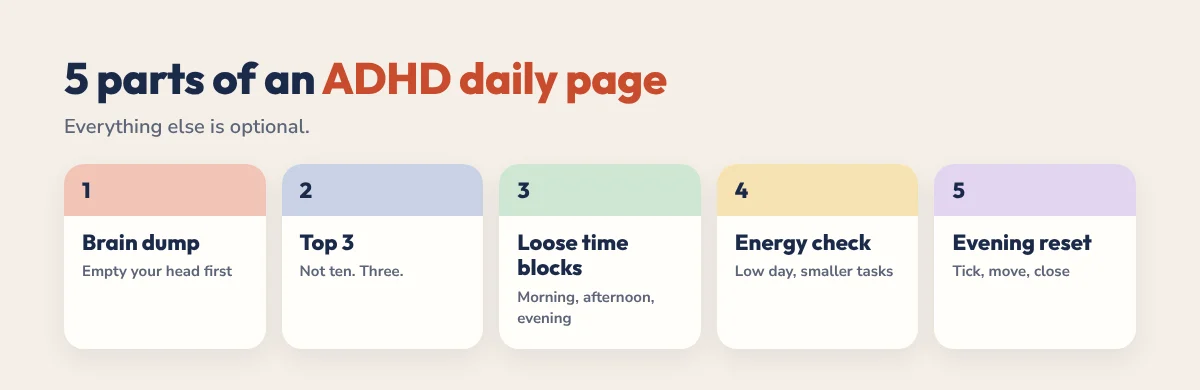
- Brain dump. A small box to empty your head before you plan. Everything goes here first: tasks, worries, ideas, things to buy.
- Top 3. The three things that would make today a good day. Not ten. Three.
- Loose time blocks. Morning, afternoon and evening, or two or three rough blocks. Put each Top 3 task in one.
- Energy check. A quick low, medium or high. On a low day, pick smaller tasks and go easy on yourself.
- Evening reset. Tick what’s done, move anything unfinished to tomorrow’s brain dump and close the planner.
Optional extras that help many people: a water or meds checkbox, a short habit tracker and a dopamine menu for when motivation is low.
Plan Your Day in 5 Minutes

| Minute | What to do |
|---|---|
| 1 | Brain dump everything on your mind. Don’t sort it yet. |
| 2 | Circle your Top 3. Ask: what has a deadline, and what will I feel best about finishing? |
| 3 | Give each Top 3 a rough block: morning, afternoon or evening. |
| 4 | Check your calendar for fixed appointments and move a block if they clash. |
| 5 | Mark your energy and pick the first small step of task 1. |
That’s it. If you have time, break task 1 into its first 10-minute step so starting is easy. A visual timer helps with that first step.
Three Example Days
A busy workday
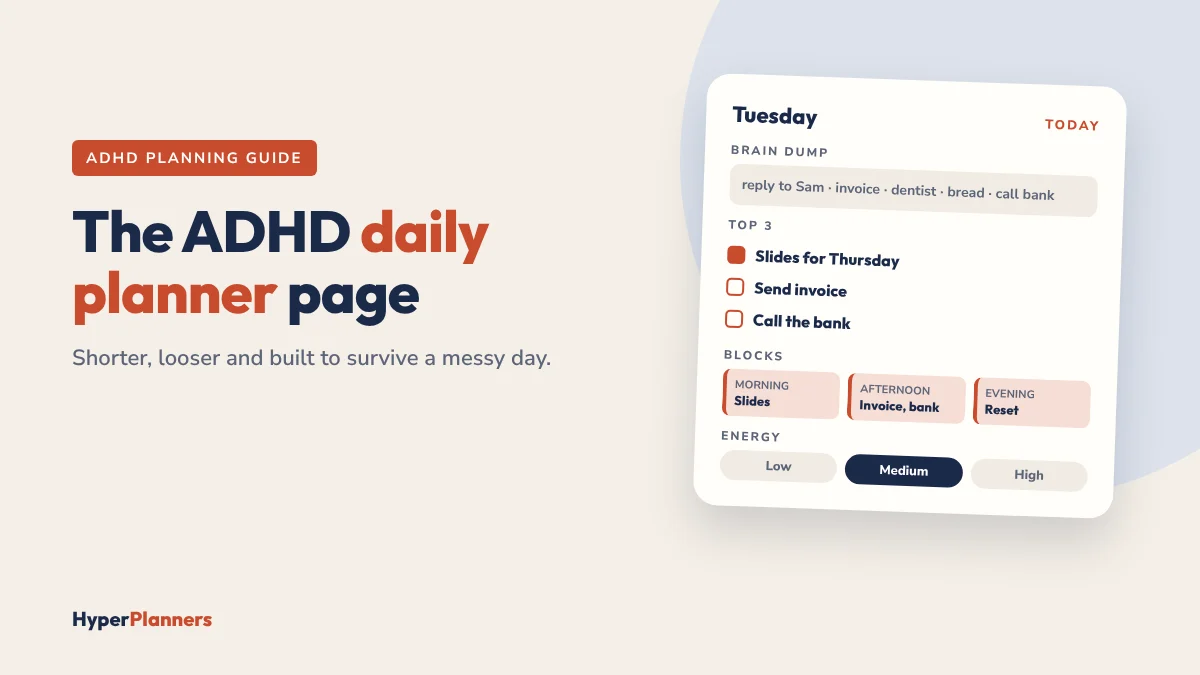
- Brain dump: reply to Sam, invoice, dentist, buy bread, slides for Thursday, call bank.
- Top 3: slides for Thursday (morning), invoice (afternoon), call bank (afternoon).
- Energy: medium.
- Evening reset: slides and invoice done. Bank call moves to tomorrow.
A low-energy day
- Brain dump: laundry, emails, gym, plan the weekend, tidy desk.
- Top 3: answer the two urgent emails, one load of laundry, a 10-minute walk.
- Energy: low. Three small wins still count.
- Evening reset: all three done. Weekend plan stays in the brain dump.
A study day
- Brain dump: essay outline, read chapter 4, lab report, email tutor, groceries.
- Top 3: essay outline (morning), read chapter 4 (afternoon), email tutor (5 minutes after lunch).
- Energy: high in the morning, low after 4pm.
- Evening reset: outline and email done, chapter 4 half read and moved to tomorrow.
Notice what’s missing: no hourly grid, no 12-item list and no guilt about what moved.
Want to try this layout today? Download our free daily planner template, a one-page PDF you can print or use in GoodNotes.
Paper, Digital or App?
| Paper planner | Digital planner (PDF on a tablet) | Planner app | |
|---|---|---|---|
| Best for | Tactile, no screens | Handwriting plus links between pages | Reminders and alerts |
| Missed days | Blank pages stay | Skip to today in one tap | No pages to skip |
| Moving tasks | Rewrite or cross out | Erase and move | Drag and drop |
| Watch out for | Leaving it at home | Needs a tablet and a note app | Notifications you start ignoring |
Many people with ADHD use a calendar for anything with a fixed time and a daily planner for priorities and thinking. If you want the calendar side handled automatically, see how an AI calendar helps you protect focus time with ADHD.
When You Miss a Day (or a Week)
You will. Everyone does. The important part is how quickly you come back.
- Don’t fill in the gaps. Skip straight to today.
- Do a 2-minute brain dump. Get what’s on your mind out first.
- Pick just one task. Your first day back only needs one win.
- Use undated or easy-restart pages. If blank dated pages make you avoid the planner, choose a layout that doesn’t punish missed days.
Once a week, a short weekly reset catches anything that slipped and keeps your daily pages realistic.
The HyperPlanners ADHD Daily Pages
Our ADHD planners are built around these ideas: a daily Top 3, brain dump, energy check, dopamine menu and habit trackers, with a no-guilt restart on every page and links that take you to today in one tap.
- Free ADHD Lite: a 31-page hyperlinked planner for 2027 to try the daily layout. Download it free.
- 2027 ADHD Planner: 490 hyperlinked pages with 365 daily pages, 53 weeks and 12 months, 4 themes and 72 covers, from $19. See the ADHD Planner.
Both work in GoodNotes, Notability and other PDF apps on iPad and Android tablets. New to digital planners? Here’s how to use a digital planner on iPad or Android. Not sure which planner fits? Take our planner quiz or build a day with the free daily schedule tool.
For a wider look at features and planner types, read our guide to the best ADHD planner for adults.
FAQ
What should an ADHD daily planner include?
A brain dump, a Top 3 instead of a long to-do list, loose time blocks, a quick energy check and a short evening reset. Optional extras include a habit tracker and a dopamine menu.
How do I plan my day with ADHD?
Spend five minutes each morning: brain dump everything, circle your Top 3, give each a rough morning, afternoon or evening block, check your calendar and mark your energy. Then start with the first small step of task 1.
Is a digital or paper daily planner better for ADHD?
It depends on how you work. Paper is tactile and screen-free. A hyperlinked digital planner lets you jump to today in one tap and erase and move tasks easily. Many people combine a planner for priorities with a calendar app for fixed appointments.
How many tasks should I plan per day with ADHD?
Start with three. A Top 3 is easier to start and finish than a long list. If you finish them, you can always add one more.
What if I keep skipping my daily planner?
Don’t fill in missed days. Skip to today, do a 2-minute brain dump and pick one task. Choose a planner with undated or easy-restart pages so missed days don’t make you avoid it.
Is there a free ADHD daily planner?
Yes. HyperPlanners ADHD Lite is a free 31-page hyperlinked planner for 2027 with ADHD-friendly daily pages. It works in GoodNotes, Notability and other PDF apps.