
You know you need to plan. You have the intention. But when you sit down with your planner, something breaks.
Time feels abstract. The weeks blur together. Yesterday, today, and next week all feel equally “now” — or equally “not now.” And the planner, which assumes you can feel time passing, becomes useless.
This is ADHD time blindness. And paper planners were never built for your brain.
Time blindness isn’t laziness or poor planning. It’s how your ADHD brain actually processes time—and the right tool can fix what willpower never could.
What is ADHD time blindness — and why does it make planning so hard?
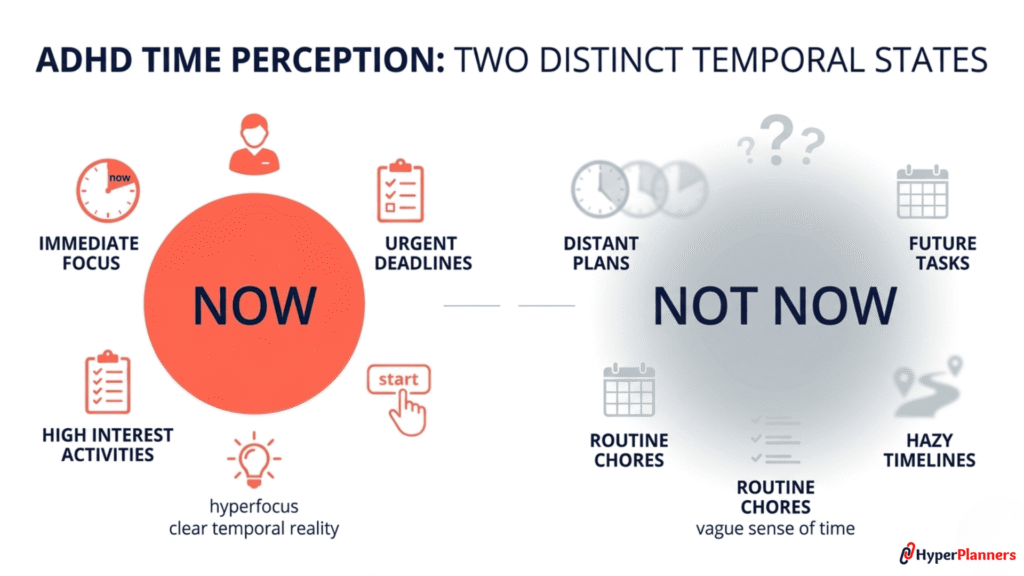
ADHD brains don’t experience time the way neurotypical brains do. For most people, time is a line — you move through it, feel its passage, anticipate what’s coming next.
For ADHD brains with time blindness, time is a series of disconnected moments. There’s now and there’s not now. Everything else is invisible.
This is neurological. Not laziness. Not lack of discipline. It’s how your brain is wired — and once you understand it, everything makes sense. Why you lose track of hours. Why deadlines feel sudden. Why you can’t estimate how long tasks take.
Time isn’t something you can feel. You have to see it.
Traditional planners assume you can feel time. They ask you to estimate, anticipate, and project yourself into a future that doesn’t feel real. For ADHD brains with time blindness, that’s like asking someone without sight to navigate by looking around.
The planner isn’t the problem. Your brain isn’t the problem. It’s a mismatch between the tool and how your brain actually works.
Why paper planners make ADHD time blindness worse
Paper planners are static. You open them, you see a week or a month, and nothing changes. There’s no motion, no feedback, nothing to make time feel real.
The switching cost kills momentum To move from your daily page to your weekly view, you flip back and forth — three pages forward, two back, now you’re in the monthly section. Every switch is friction. And for ADHD brains, friction leads to abandonment.
The blank pages create guilt Half-filled day after half-filled day. Pages you meant to use but didn’t. That visual reminder of incompleteness isn’t motivating for ADHD brains — it’s shame-inducing. By week three, you’re avoiding your planner because looking at it hurts.
There’s no anchor Without tactile feedback or motion, you have to think about where you are in your week, estimate it, feel it. For time-blind brains, that requires cognitive effort you don’t have. So you stop checking. And if you’re not checking, you’re not planning.
How a hyperlinked digital planner solves ADHD time blindness
A hyperlinked digital planner creates external structure where your internal time sense falls short.
Instant navigation — zero switching cost
You tap a link and you’re on the page you need. One second, not thirty. No flipping. No searching. Friction is what kills ADHD habits. Remove the friction and the habit survives.
Always know where you are in your week
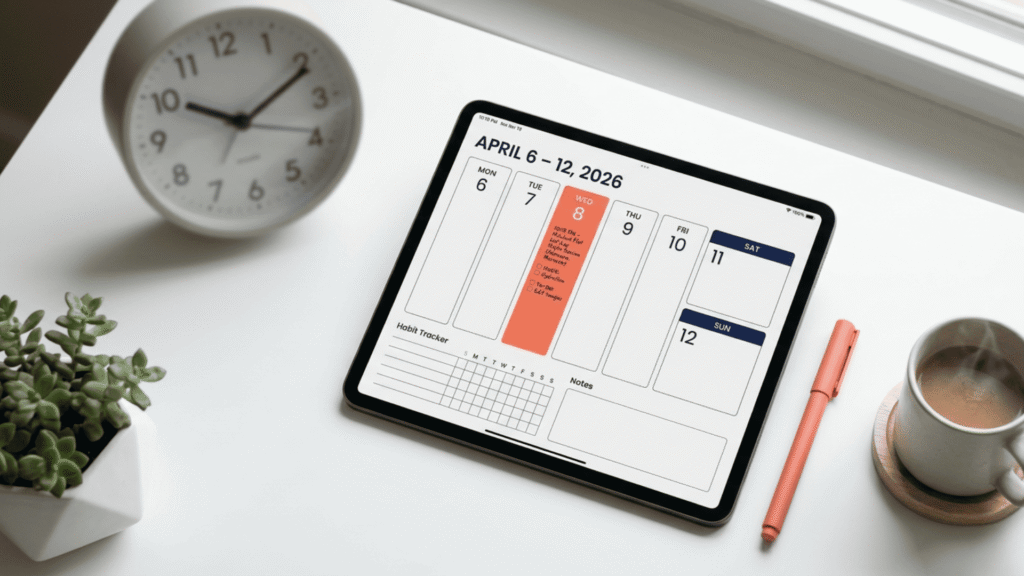
A well-designed digital planner shows you Monday through Friday at a glance. You can see where you are. You can see what’s coming. Time becomes visible in a way paper never was.
Reduces working memory load
You don’t have to remember where things are or mentally navigate your planner structure. You tap a link and you’re there — freeing up cognitive energy for actual planning instead of using the planner.
Time blindness affects up to 80% of adults with ADHD. It is not a character flaw — it is how your brain processes time differently. The right tools create external structure so you don’t have to rely on internal time sense alone.
Ready to see how this works? Explore our hyperlinked digital planners designed specifically for ADHD time blindness.
The exact setup that works for ADHD time blindness
Here’s the setup that actually works for time-blind ADHD brains:
Step 1: Import to GoodNotes or Notability
Download your hyperlinked planner PDF. Import it to GoodNotes or Notability on your iPad. That’s it—no apps to learn, no new workflows.
Step 2: Use Your Daily View as a Morning Anchor
Every morning, open your daily page. Write three things: what you’re planning to do today, any hard stops or meetings, one thing that would make today feel successful. That’s your anchor—your way of saying “I am here, this is now, this is what matters today.”
Step 3: Check Your Weekly View Once Daily
Tap to your weekly view. See the shape of your week at a glance. You don’t have to update it. Just see it. This visual makes time real in a way paper never did.
Step 4: Monthly View Is Your North Star
Once a week (not daily), tap to your monthly view. This is your long-term structure. It’s not meant to be detailed—just enough to make the month feel real, not abstract.
That’s it. Daily anchor, weekly check, monthly overview. The hyperlinks make this take five minutes instead of thirty. And the simplicity means you’ll actually do it.
ADHD time blindness: what the research says
Time blindness affects a significant proportion of adults with ADHD. It is not a character flaw — it is how your brain processes time differently. The right tools create external structure so you don’t have to rely on internal time sense alone.
Time blindness is hard. It won’t go away with willpower. But the right structure — one that makes time visible instead of asking you to feel it — changes everything.
It takes a few days to build the habit. The planner removes the friction, but you still have to open it. Once you do, once you see how much easier planning becomes when you can actually see your time instead of trying to feel it, you’ll understand why this works.
Your brain isn’t broken. Time blindness is just your brain’s way of working. The right planner is one that works the way your brain actually works.